

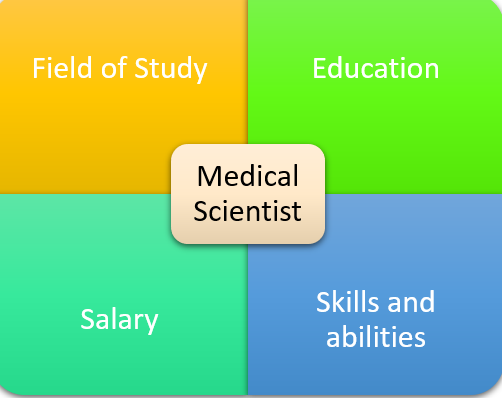
Field and Career
Medical Scientists work on human healthcare, they find the cause of diseases and try to prevent or treat the disease.
Medical Scientists could be: Cancer researchers; Medical researchers, Clinical and medical informaticians; Neuroscientists; Immunochemists;…
https://www.youtube.com/watch?v=RGK3VKkyVxs
Education

To study about medical science in Canada, a person must attend either College or University. In general, they are required to have Ontario Secondary School Diploma, credits of Science subject such as: Biology, Chemistry, Physic and English 12. ( To apply for universities, students need to have at least six credits of grade 12 university preparation subjects)
Here is Medical Science Study Admission Requirement from Brock University: https://brocku.ca/programs/undergraduate/medical-sciences/
Studying medical science takes a person 4 years of university but they usually spend the first 2 years in doing lab.
To be a medical scientist, people need to have either a Bachelor of Science degree (in Biology, Chemistry, and Biochemistry) or Master of Science program or a Ph.D. program.
Salary
While medical scientists at entry level only make $23, 061 (per year) approximately, experienced workers can earn double amount (up to $45,597 per year). The average income that medical scientists in Canada make is around $26,822 per year or $13.75 per hour.
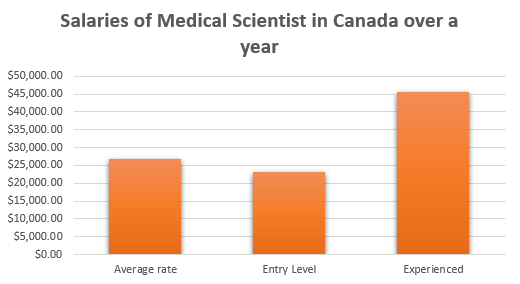
As observed from the graph and the information above, the salary for medical scientists is not very high in general. Furthermore, it is not easy to find a job in this field for beginners because employers usually prefer experienced workers or employee must have great study results and practicing experiences.
Skill and Abilities
A good medical scientist must have communication skill and critical thinking to communicate well and explain their view or opinions. Moreover, they should also have data-analysis skill, good observation and decision making.
Medical scientists must be able to
- Understand the study that investigates human diseases, caring methods and treatment of diseases
- Develop instruments for medical applications
- Investigate causes and treatment of diseases or toxicant by collecting and preparing samples
- Standardize medicine and drug
- Work with different departments and people to develop programs that improve health outcomes
- Follow procedures to maintain safety while working or examining
 Jennifer's blog